Тип
LORA
Время публикации
2025-09-10
Базовая модель
Qwen-Image
Слово-триггер
Porsche962C
Копировать
Версия введения.
Initial release of the LoRA.

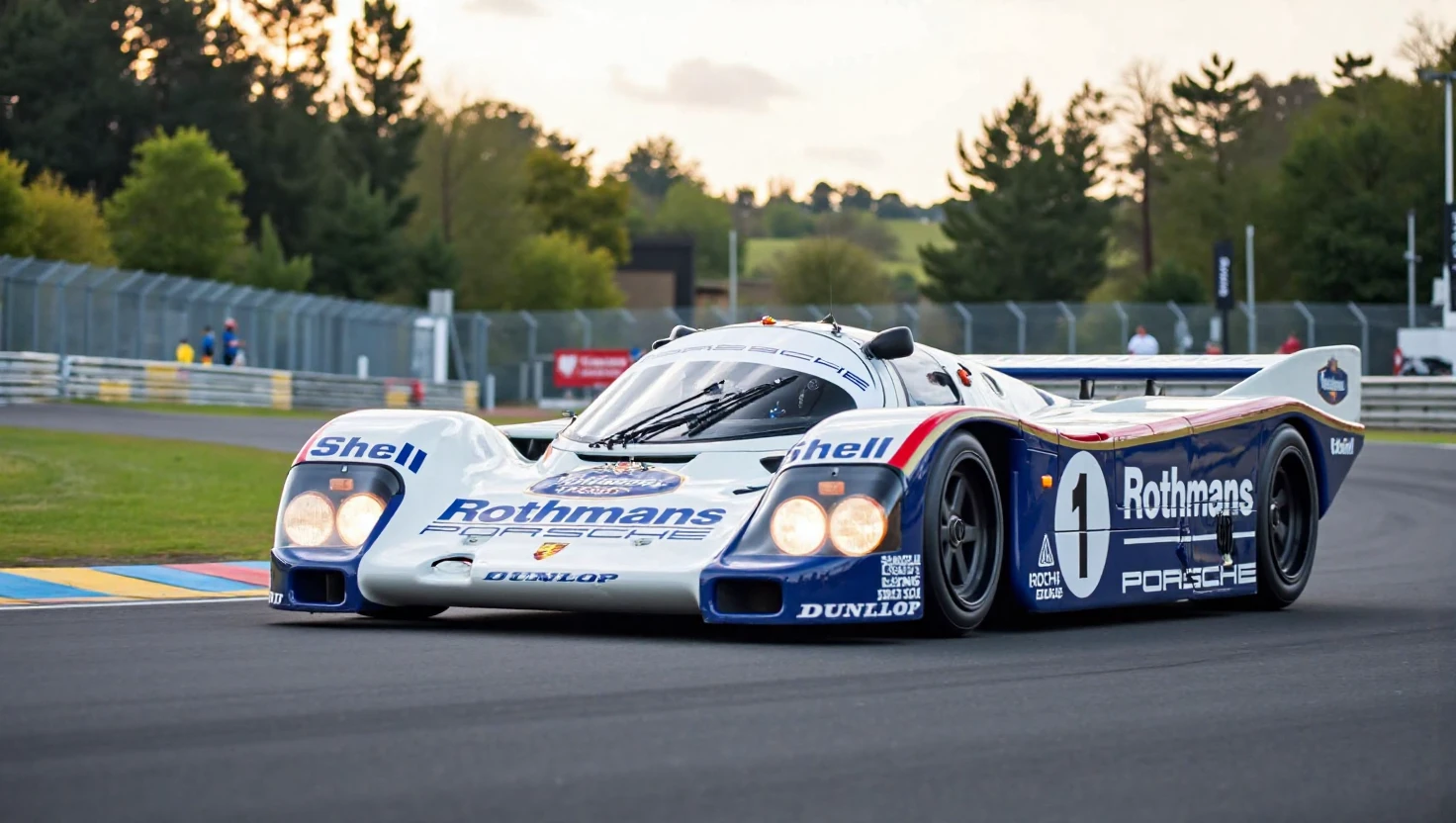
This adaptability was the core of its 1985 success, with the car existing in two distinct specifications. For the sprint-oriented IMSA GTP championship, the 962 used a robust, air-cooled flat-six engine with a large single turbocharger, eventually displacing 3.2 liters and producing up to 750 horsepower. For the fuel-restricted FIA World Sportscar Championship (WSC), the car was designated the 962C and retained the 956's more complex, fuel-efficient 2.65-liter twin-turbo engine with water-cooled cylinder heads. Both variants utilized the revolutionary ground-effect aerodynamics pioneered by the 956, generating immense downforce that glued the car to the track.
In America, the 962's first full season was a campaign of near-total annihilation. It won 16 of the 17 IMSA GTP races, sweeping the prestigious 24 Hours of Daytona and 12 Hours of Sebring. The charge was led by Al Holbert's iconic Löwenbräu-sponsored team, which took nine victories and the driver's championship. The car's success was amplified by a fleet of customer teams, including Dyson Racing and Busby Racing, who made the 962 the undisputed king of the American grid.
In the World Championship, the works Rothmans Porsche team deployed the new 962C and continued its dynasty, securing both the Teams' and Drivers' championships for Derek Bell and Hans-Joachim Stuck. The season was highlighted by a famous paradox at the 24 Hours of Le Mans. Despite Hans-Joachim Stuck setting a blistering, record-breaking pole position lap, the new works 962Cs were defeated by a privateer Joest Racing team running a fully-developed, older Porsche 956. This outcome, however, was not a failure but the ultimate validation of Porsche's customer racing philosophy—even when the factory lost, a Porsche still won.
The 1985 season established the 962's enduring legacy. It became the definitive customer prototype, its fundamentally sound design serving as a competitive platform for nearly a decade and as a testbed for future technologies like the PDK transmission. Its dominance forced rivals to innovate, with the late-season arrival of the carbon-fiber Jaguar XJR-6 foreshadowing the next technological leap in the sport. The 1985 Porsche 962 was more than a champion; it was the benchmark that defined an entire era of endurance racing.

Initial release of the LoRA.
1. Права на репостнутые модели принадлежат оригинальным создателям.
2. Для подтверждения авторства модели создателям следует обратиться к сотрудникам SeaArt AI через официальные каналы. Нажмите, чтобы подтвердить
