類型
LORA
发布時間
2025-08-03
基础模型
Flux.1 D
触发词
La4ni2us
Red-tailed Shrike
Lanius phoenicuroides
復制


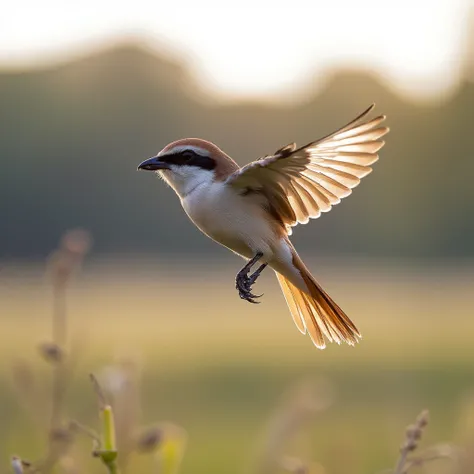
The Red-tailed Shrike, scientifically known as Lanius phoenicuroides, is a medium-sized passerine bird belonging to the shrike family, Laniidae. It is also commonly referred to as the Turkestan Shrike. This species is noted for its distinctive appearance and fascinating predatory habits.
Appearance
The Red-tailed Shrike measures approximately 17 to 19 centimeters in length. It has a fairly large head and a strong, hooked bill, characteristic of the shrike family. The upperparts are sandy-brown, while the underparts are typically whitish or buff. The most distinguishing feature, as its name suggests, is its rufous-red tail. A prominent black mask extends from the base of the bill through the eye to the ear-coverts. Females are generally duller in coloration than males, with a less pronounced mask and sometimes faint barring on the flanks.
Habitat and Distribution
The Red-tailed Shrike breeds in open, arid to semi-arid habitats with scattered bushes and trees. This includes steppes, scrublands, open woodlands, and agricultural areas. Its breeding range extends from Central Asia, including southern Siberia, Kazakhstan, and Iran, eastward to northwestern China.
Migration
This bird is a long-distance migrant. It spends the breeding season in its Central Asian range and migrates to its wintering grounds in East and Northeast Africa, as well as the Arabian Peninsula. During migration, they can be found in a wider variety of open habitats, including coastal areas and gardens. The spring migration to the breeding grounds occurs from February to May, and the autumn migration to the wintering grounds takes place from August to October.
Diet and Feeding
The Red-tailed Shrike is a carnivorous bird. Its diet primarily consists of large insects, such as beetles, grasshoppers, and crickets. It also preys on other small invertebrates like spiders and scorpions. Notably, it is capable of taking small vertebrates, including lizards, small rodents, and even other small birds.
Like other shrikes, the Red-tailed Shrike has a unique and well-documented hunting behavior. It often perches on a prominent vantage point, such as the top of a bush or a wire, scanning the ground for prey. Once prey is spotted, it will swoop down to capture it. A fascinating and somewhat macabre habit of shrikes is to impale their prey on thorns, sharp twigs, or barbed wire. This "larder" serves as a food cache for later consumption and also helps the bird to dismember larger prey items, as it lacks strong talons.
Important Information
Taxonomy: The Red-tailed Shrike was formerly considered a subspecies of the Isabelline Shrike (Lanius isabellinus). However, it is now widely recognized as a distinct species.
Vocalization: Its call is a series of harsh, scolding notes. The song is a quieter, more musical warbling that may incorporate mimicry of other birds' songs.
Conservation Status: The Red-tailed Shrike is currently listed as a species of "Least Concern" by the International Union for Conservation of Nature (IUCN). This is due to its large range and apparently stable population.
Behavior: They are typically solitary or found in pairs. They are known to be bold and territorial, especially during the breeding season.


1. 轉载模型僅供學習與交流分享,其版權及最終解释權归原作者。
2. 模型原作者如需認領模型,請通過官方渠道联系海藝AI工作人員進行認證。我們致力於保護每一位創作者的權益。 點擊去認領
